
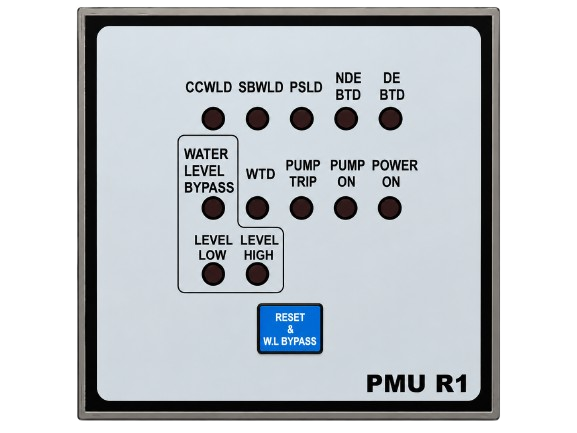
A Pump Monitor Unit (PMU) is an electronic control and protection device used to continuously monitor the operating condition of pumps and ensure safe, efficient, and reliable performance.
Main Purpose
The primary role of a pump monitor unit is to:
Protect pumps from abnormal operating conditions
Improve pump efficiency
Reduce downtime and maintenance cost
Prevent damage due to dry run, overload, or abnormal pressure/flow
Key Parameters Monitored
A typical pump monitor unit tracks one or more of the following:
Motor current (load monitoring)
Voltage
Power consumption
Dry run condition (no water flow)
Overload / underload
Phase failure / phase imbalance
Temperature (motor or bearing)
Pressure and flow (in advanced systems)
Run hours and start/stop cycles
Working Principle
The unit continuously receives electrical and/or sensor inputs from the pump system. It compares real-time values with preset safe limits. If any abnormal condition is detected, it:
Triggers an alarm (visual or audible)
Sends a signal to SCADA/PLC (in industrial setups)
Automatically stops the pump to prevent damage
Types of Pump Monitor Units
Basic current-based monitor (protects against dry run & overload)
Advanced digital pump controller
SCADA-integrated pump monitoring system
IoT-based smart pump monitoring unit
Features
LCD/LED display of parameters
Adjustable setpoints
Automatic trip and restart logic
Alarm outputs and relay contacts
Data logging and communication (Modbus, RS485, etc.)
Remote monitoring capability (in modern systems)
Applications
Water supply and distribution systems
Borewell and submersible pumps
Sewage and wastewater treatment plants
Industrial process pumps
Irrigation systems
Boiler feed water systems
Simple Definition
A Pump Monitor Unit is a protective control system that continuously monitors pump performance and automatically prevents damage by detecting abnormal operating conditions like dry run, overload, or phase failure.
| Parameter | Typical Specification |
|---|---|
| Application | Centrifugal pumps, submersible pumps, process pumps |
| Supply Voltage | 24 V DC, 110 V AC, or 230 V AC |
| Power Consumption | < 10 W |
| Input Signals | Pressure, flow, level, vibration, temperature, motor current |
| Analog Inputs | 4–20 mA, 0–10 V |
| Digital Inputs | Dry contact, PNP/NPN signals |
| Output Signals | Relay outputs, 4–20 mA, Modbus communication |
| Communication Protocols | Modbus RTU/TCP, Ethernet, RS-485 (model dependent) |
| Display | LCD/LED local display |
| Data Logging | Event and alarm history storage |
| Protection Class | IP65/IP66 |
| Operating Temperature | −20°C to +60°C |
| Humidity | 5–95% RH, non-condensing |
| Mounting | Panel mount or DIN rail mount |
| Alarm Functions | Visual and audible alarms |
| Certification | CE, UL, IEC compliant (depending on model) |
