
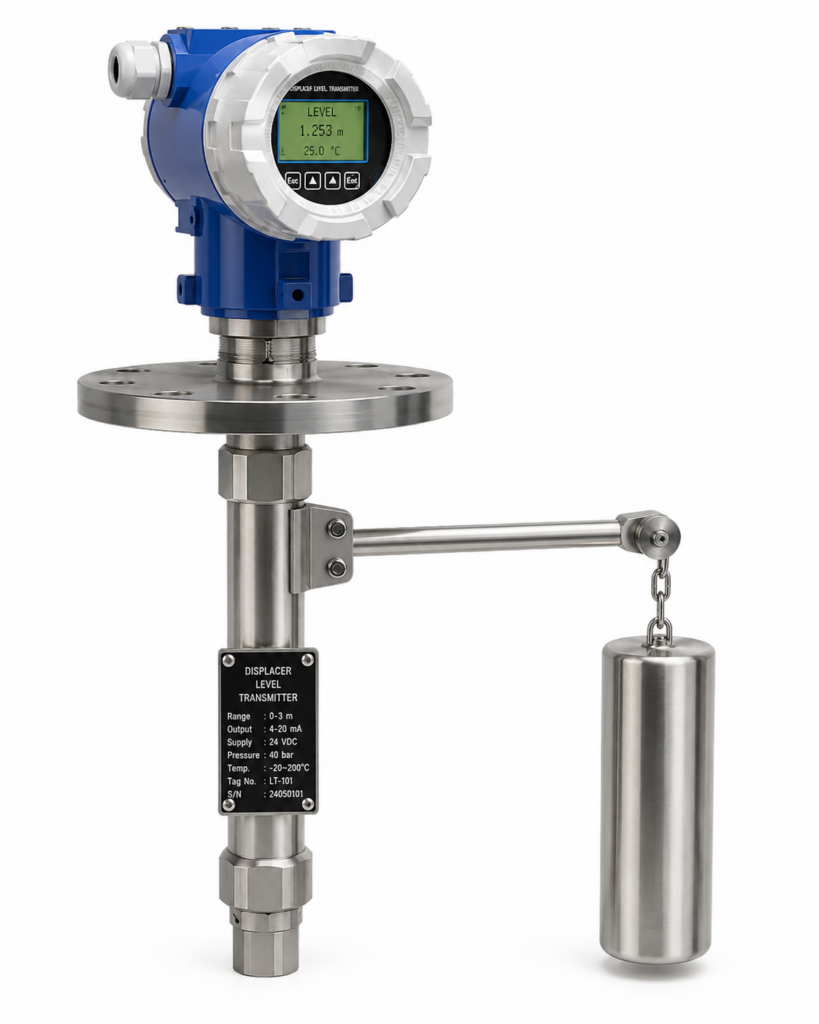
A Displacer Level Transmitter is a continuous level measurement instrument that operates on the buoyancy principle (Archimedes’ Principle). A cylindrical displacer is suspended in the process liquid, and the buoyant force acting on it changes proportionally with the liquid level. This change in force is detected by a torque tube or force-balance mechanism and converted into a standard electrical output signal, typically 4-20 mA, for monitoring and control.
Displacer Level Transmitters are widely used for measuring liquid level, interface level, and density in tanks, vessels, separators, and pressure vessels. They are particularly suitable for applications involving high temperature, high pressure, and varying process conditions where conventional float-based devices may not be suitable.
| Parameter | Specification |
|---|---|
| Instrument Type | Displacer Level Transmitter |
| Measuring Principle | Buoyancy / Archimedes Principle |
| Measurement | Continuous Level, Interface Level, Density |
| Measuring Range | Up to 6 m (application dependent) |
| Accuracy | ±0.5% of Span |
| Output Signal | 4-20 mA, HART Protocol |
| Power Supply | 12-36 VDC |
| Process Connection | Flanged / Threaded |
| Wetted Material | SS316, SS304, Hastelloy (Optional) |
| Housing Material | Die-cast Aluminum / SS316 |
| Process Temperature | -196°C to +400°C (model dependent) |
| Process Pressure | Vacuum to 400 bar (model dependent) |
| Protection Class | IP66 / IP67 |
| Application | Storage Tanks, Separators, Boilers, Interface Measurement |
