
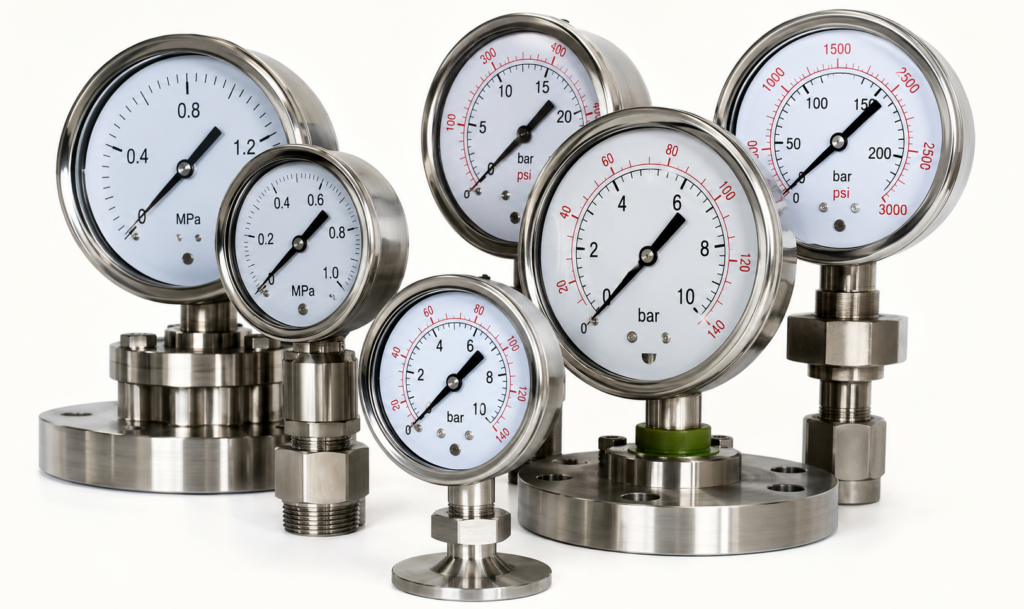
A Pressure Gauge is a mechanical or digital instrument used to measure and display the pressure of liquids, gases, or steam within a system. It helps operators monitor process conditions and ensure equipment operates within safe pressure limits.
Pressure gauges work by sensing the force exerted by a fluid on a sensing element (such as a Bourdon tube, diaphragm, or pressure sensor) and converting it into a readable pressure value.
They are widely used in:
A Pressure Gauge is an instrument that measures and displays the pressure of fluids or gases in a system, helping maintain safe and efficient operation of industrial processes.
| Parameter | Specification |
|---|---|
| Type | Mechanical / Digital Pressure Gauge |
| Measured Parameter | Pressure of liquids, gases, or steam |
| Sensing Element | Bourdon Tube / Diaphragm / Pressure Sensor |
| Pressure Range | Vacuum to 1000 bar (model dependent) |
| Units | bar, psi, kg/cm², kPa, MPa |
| Accuracy | ±1.0% to ±2.5% FS |
| Dial Size | 50 mm, 63 mm, 100 mm, 150 mm |
| Process Connection | 1/4″, 1/2″ BSP/NPT (typical) |
| Wetted Parts | Brass, Stainless Steel (SS304/SS316) |
| Operating Temperature | -20°C to +60°C (typical) |
| Mounting | Bottom entry / Back entry / Panel mount |
| Applications | Pumps, pipelines, boilers, compressors, water treatment, industrial processes |
| Parameter | Technical Data |
|---|---|
| Instrument Type | Mechanical / Digital Pressure Gauge |
| Measured Variable | Pressure of liquids, gases, and steam |
| Measurement Principle | Bourdon tube, diaphragm, or electronic pressure sensing |
| Pressure Range | Vacuum to 1000 bar (model dependent) |
| Units | bar, psi, kg/cm², kPa, MPa |
| Accuracy | ±1.0% to ±2.5% Full Scale (FS) |
| Dial Size | 50 mm, 63 mm, 100 mm, 150 mm |
| Case Material | Stainless Steel / Mild Steel / ABS |
| Wetted Parts | Brass, SS304, SS316 |
| Process Connection | 1/4″, 3/8″, 1/2″ BSP/NPT |
| Mounting Type | Bottom Entry, Back Entry, Panel Mount |
| Operating Temperature | -20°C to +60°C |
| Ambient Humidity | Up to 95% RH (non-condensing) |
| Protection Rating | IP54 to IP67 (model dependent) |
| Fill Fluid | Dry or Glycerine-filled for vibration damping |
| Display Type | Analog dial / Digital display |
| Power Supply | Not required (mechanical), battery/external supply (digital) |
| Response Time | Instantaneous mechanical indication |
| Applications | Water treatment, pumps, compressors, boilers, hydraulic and pneumatic systems |
Summary: A pressure gauge is a reliable instrument for monitoring system pressure, available in mechanical or digital versions, with a wide measurement range and durable construction for industrial applications.
