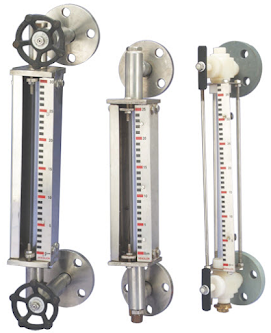
Level Gauge

Level Gauge


Level Gauge – Description

  • A level gauge (often called a level indicator) is an instrument used to measure and display the level of liquids or solids inside a tank, vessel, boiler, or container. It helps operators know how much material is present at any given time.
  • A level gauge provides a visual or electronic indication of the height of a substance relative to a reference point (usually the bottom of a tank). It is widely used in industries like oil & gas, chemical processing, water treatment, and power plants.

⚙️ Main Types of Level Gauges

1. Sight Glass Level Gauge

  • A transparent tube or window mounted on the tank
  • Liquid level is directly visible
  • Simple and inexpensive, but limited to safe pressures/fluids

2. Magnetic Level Gauge

  • Uses a float with magnets inside a sealed chamber
  • External indicator shows level using magnetic flags
  • Works well for high pressure or hazardous liquids

3. Float-Type Level Gauge

  • A float moves with liquid level
  • Mechanical linkage or sensor converts motion into reading
  • Common in storage tanks

4. Electronic / Radar Level Gauge

  • Uses radar, ultrasonic, or capacitance signals
  • No direct contact with liquid (in many cases)
  • High accuracy and suitable for large industrial tanks

📌 Key Functions

  • Measures liquid or solid level continuously or at set points
  • Prevents overflow and dry-run conditions
  • Helps in process control and inventory management
  • Improves safety in industrial systems

🏭 Applications

  • Water tanks and reservoirs
  • Oil storage tanks
  • Chemical reactors
  • Boilers and steam systems
  • Food and beverage processing


  • Specification
Parameter Specification (Typical)
Purpose Measures liquid level in tanks/vessels
Measured Medium Liquids (water, oil, chemicals, steam)
Types Sight glass, magnetic, float type, radar/ultrasonic
Measurement Range Few cm to 30+ meters (depends on type)
Accuracy ±0.5% to ±2% (higher for radar types)
Operating Pressure Atmospheric to high-pressure systems (up to ~400 bar for magnetic types)
Operating Temperature -50°C to 400°C (depends on model/material)
Material of Construction Stainless steel, carbon steel, glass, PTFE
Output Type Visual / Analog / Digital (4–20 mA, HART, Modbus)
Installation Side-mounted, top-mounted, or external chamber
Maintenance Low to moderate (depends on type)
Applications Industrial tanks, boilers, chemical plants, storage vessels
logo
Go Back Top