
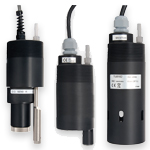
Dissolved Oxygen (DO) is a key indicator of water quality and ecosystem health. It represents how much oxygen from the atmosphere or produced by aquatic plants is mixed into water and remains available for respiration.
Oxygen enters water mainly through:
It is removed from water through:
Dissolved Oxygen is widely used in:
| Parameter | Technical Details |
|---|---|
| Measured Quantity | Oxygen gas (O₂) dissolved in aqueous solution |
| Chemical Basis | O₂ partial pressure equilibrium with water |
| Units | mg/L (primary), ppm (equivalent in water), % saturation |
| Typical Measurement Range | 0 – 20 mg/L (natural waters usually 0 – 14 mg/L) |
| Saturation Value (Freshwater, 25°C, 1 atm) | ~8.26 mg/L |
| Saturation Value (Seawater, 25°C) | ~6.5 – 7.0 mg/L (lower due to salinity) |
| Zero Oxygen Condition | 0 mg/L (anaerobic conditions) |
| Sensor Types | Electrochemical (galvanic / polarographic), Optical (luminescent) |
| Electrochemical Principle | Oxygen diffuses through membrane → reduced at cathode → current generated |
| Optical Principle | Oxygen quenches luminescent dye; phase shift measured |
| Accuracy | ±0.1 to ±0.2 mg/L (typical modern sensors) |
| Resolution | 0.01 mg/L (high-end probes) |
| Response Time (T90) | ~5–30 sec (optical), ~30–60 sec (electrochemical) |
| Operating Temperature Range | 0 – 50°C (sensor dependent) |
| Temperature Compensation | Automatic (built-in thermistor) |
| Pressure Compensation | Required for accurate % saturation |
| Salinity Compensation | Required for marine applications |
| Calibration Methods | Air-saturation (100%), zero calibration (Na₂SO₃ solution) |
| Drift | Low in optical sensors, moderate in membrane sensors |
| Maintenance Requirement | Membrane replacement (electrochemical), minimal for optical |
| Key Influencing Factors | Temperature, pressure, salinity, biological activity |
| Critical Thresholds | <2 mg/L hypoxic, <0.5 mg/L anoxic |
| Primary Applications | Aquaculture, wastewater treatment, rivers/lakes monitoring, process water control |
| Parameter | Specification |
|---|---|
| Units | mg/L (milligrams per liter), ppm (parts per million) |
| Measurement Range | 0 to ~20 mg/L (natural waters typically 0–14 mg/L) |
| Saturation Range (freshwater, 25°C) | ~8.3 mg/L (varies with temperature & pressure) |
| Measurement Methods | Electrochemical (galvanic/polarographic) or optical (luminescence) |
| Sensor Types | Membrane electrode, optical DO probe |
| Accuracy | ±0.1 to ±0.2 mg/L (typical modern sensors) |
| Resolution | 0.01 mg/L (high precision instruments) |
| Response Time | 5–60 seconds (sensor-dependent) |
| Temperature Compensation | Automatic (built-in temperature sensor) |
| Calibration Methods | Air-saturation calibration or zero-oxygen calibration (sodium sulfite) |
| Temperature Dependence | Solubility decreases as temperature increases |
| Salinity Effect | Higher salinity → lower oxygen solubility |
| Pressure Effect | Higher pressure → higher dissolved oxygen |
| Typical Healthy Range | 5–8 mg/L for most aquatic life |
| Critical Low Level | <3 mg/L (stress condition), <2 mg/L (hypoxic) |
| Key Influences | Temperature, biological activity, atmospheric exchange, salinity |
| Primary Applications | Aquaculture, wastewater treatment, environmental monitoring, drinking water systems |
