
Conductivity

Conductivity

Conductivity – Description

Electrical Conductivity (EC) describes how easily an electric current can pass through a substance, especially liquids containing dissolved ions.


⚡ 1. Definition

Electrical conductivity is the ability of a solution to carry electric charge, mainly through the movement of:

  • Cations (+ ions)
  • Anions (− ions)

The more ions present, the higher the conductivity.


📏 2. Units

  • Siemens per meter (S/m) — SI unit
  • Common practical units for liquids:
    • µS/cm (microsiemens per centimeter)
    • mS/cm (millisiemens per centimeter)

🔬 3. Principle of Measurement

Conductivity is measured by applying an AC voltage between two electrodes and measuring the resulting current:

\sigma = \frac{1}{\rho}

Where:

  • σ (sigma) = electrical conductivity
  • ρ (rho) = resistivity of the material

🌊 4. In Liquids (Electrolytic Conductivity)

Conductivity depends on:

  • Ion concentration (more salts → higher EC)
  • Ion mobility (temperature dependent)
  • Type of dissolved substances (Na⁺, Cl⁻, Ca²⁺, etc.)

📊 5. Typical Conductivity Ranges

  • Ultra-pure water: ~0.05 µS/cm
  • Distilled water: ~0.5–10 µS/cm
  • Drinking water: ~50–800 µS/cm
  • River water: ~50–1500 µS/cm
  • Seawater: ~50,000 µS/cm (≈ 50 mS/cm)

🌡️ 6. Temperature Effect

  • Conductivity increases about ~2% per °C rise
  • Standardized to 25°C reference temperature

🧪 7. Measurement Setup

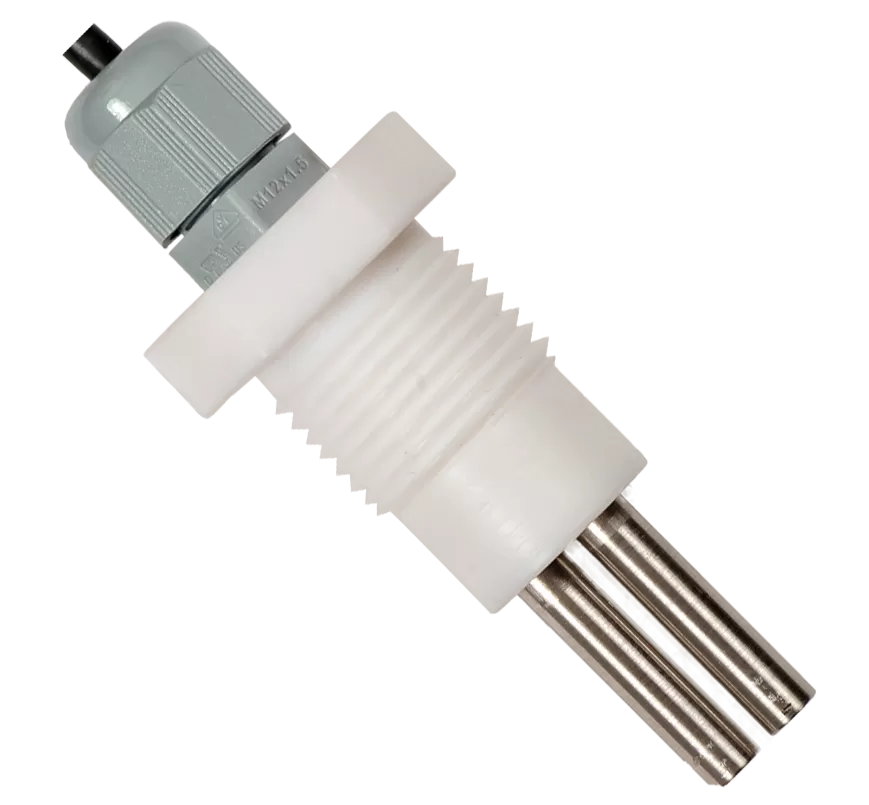
  • Conductivity cell (electrodes): graphite, platinum, or stainless steel
  • Cell constant (K): defines geometry of electrodes
  • AC excitation: prevents electrode polarization
  • Often combined with TDS (Total Dissolved Solids) estimation

🧭 8. Key Characteristics

  • Direct indicator of dissolved ionic content
  • Does not identify specific ions
  • Widely used in:
    • water quality monitoring
    • hydroponics
    • industrial process control
    • environmental testing


  • Specification
Parameter Specification
Symbol σ (sigma)
SI Unit Siemens per meter (S/m)
Common Units µS/cm, mS/cm
Electrodes Used Graphite, Platinum, Stainless Steel
Cell Constant (K) 0.1, 1.0, 10.0 cm⁻¹ (depends on probe design)
Typical Range 0.05 µS/cm (ultrapure water) to ~70 mS/cm (seawater)
Temperature Reference 25°C standard or RTD inbuilt
Temperature Compensation Automatic (built-in sensor)
Accuracy ±0.5% to ±2% full scale
Resolution 0.01 µS/cm (low range), 0.01 mS/cm (high range)
Response Time ~1–30 seconds
Calibration KCl standard solutions (1-point or multi-point)
Primary Use Water quality, hydroponics, aquaculture, industrial monitoring
logo
Go Back Top