
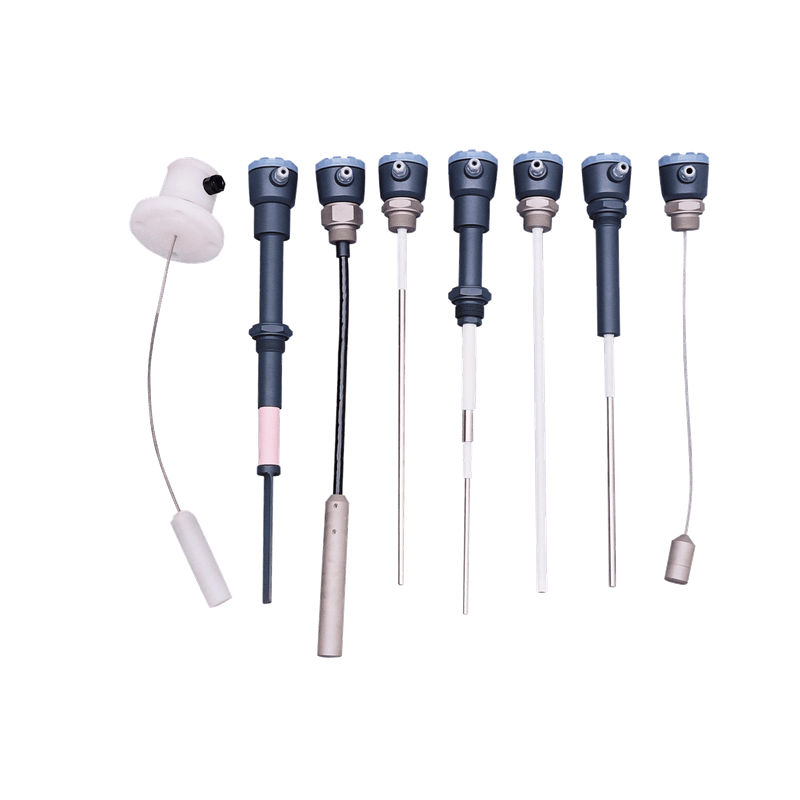
A Capacitance Level Transmitter is a continuous level measurement device that operates on the principle of capacitance change between a probe and the tank wall (or reference electrode). As the level of liquid, slurry, powder, or granular material changes, the capacitance value varies proportionally. The transmitter converts this change into a standard 4-20 mA output signal for monitoring and control purposes.
Capacitance Level Transmitters are widely used for measuring levels in storage tanks, process vessels, silos, and hoppers. They are suitable for a variety of media including liquids, conductive and non-conductive fluids, chemicals, oils, powders, and bulk solids. The instrument provides reliable and accurate level measurement even under challenging process conditions such as high temperature, high pressure, and corrosive environments.
Capacitance Level Transmitters offer a cost-effective, reliable, and maintenance-free solution for continuous level measurement in a wide range of industrial applications.
| Parameter | Specification |
|---|---|
| Measuring Principle | Capacitance Technology |
| Measurement Type | Continuous Level Measurement |
| Measuring Range | Up to 20 m (Application Dependent) |
| Accuracy | ±0.5% of Span |
| Output Signal | 4-20 mA, HART (Optional) |
| Supply Voltage | 12 to 36 VDC |
| Probe Type | Rod / Cable |
| Process Connection | Threaded / Flanged |
| Wetted Material | SS316 / PTFE Coated |
| Process Temperature | -40°C to +200°C |
| Process Pressure | Vacuum to 40 bar |
| Protection Class | IP66 / IP67 |
| Housing Material | Aluminum / SS316 |
| Hazardous Area Approval | ATEX / IECEx (Optional) |
| Applications | Liquids, Slurries, Powders & Bulk Solids |
